Tag: Attractions in Rome

  • Palatine Hill Rome

    Palatine Hill Rome

    Palatine Hill Rome

    [tab name=”History of Palatine Hill”]The Palatine Hill is situated between the Colosseum, Circus Maximus, and the Roman Forum. It is considered the birthplace of Rome. One of Rome’s seven hills, the Palatine Hill is linked with the city’s history and where many important figures lived.

    According to legend the Palatine hill was the location of a cave where two infants Remus and Romulus were brought in by a she-wolf. She kept them alive until a shepherd named Faustulus found them and he and his wife brought them up and raised them. When the two brothers were older they fought over the right to be the leader of the new settlement. Romulus eventually killed his brother at the Palatine Hill. Romulus picked this hill as an ideal place to build a new city and this became the namesake of Rome.

    Over time Palatine Hill became one of the most affluent areas in Ancient Rome and was a desirable place to live by the first century BC during the Republic. During the Roman Empire the Palatine Hill was home to Rome’s most prominent figures, Cicero, Mark Anthony, Nero and Domitian. Also the first Emperor of the Roman Empire, Augustus was born here in 63 BC.

    Domus Flavia and Domus Augustana are among the best-preserved ruins on Palatine Hill. Domitian’s palace was built in AD 81. The Domus Flavia was the wing used for state functions and the Domus Augustana; a huge and lavish palace was his private residence. The Palace of Septimius Severus was an extension of the Domus Augustana and was built during the reign of the Roman Emperor Lucius Septimius Severus.

    The Stadium of Domitian was built by Domitian, the Roman Emperor from 51-96 AD. He had a huge passion for sports so he had it built for athletic contests. It was also used for gladiatorial combats after a fire destroyed the Coliseum.

    The House of Livia dates from the 1st century BC, it is where Emperor Augustus and his wife Livia lived.

    House of Augustus will be the first major site you see upon entering the Palatine Hill. This was the modest home of Ancient Rome’s first emperor, Augustus. Visiting the house will give you first-hand experience of walking through an ancient Roman house.

    House of Tiberius was the first of the imperial palaces to be built on the Palatine Hill. It is located behind the Temple of Magna Mater and overlooks the Roman Forum.

    The Temple of Cybele was Rome’s first and most important temple to the Magna Mater, known to the Greeks as Cybele. The temple was sited on the high slope of the hill, overlooking the valley of the Circus Maximus and facing the temple of Ceres on the slopes of the Aventine.

    The Farnese Gardenn, one of the first botanical gardens in Europe was created by Cardinal Alessandro Farnese in the mid 16th century. It overlooks the Forum and the Arch of Titus.

    Temple of Victory was built by general Lucius Postumius Megellus. It was used to house Cybele’s sacred stone between 204 BC and 191 BC.

    Temple of Apollo was located next to Augustus’ house. Erected by Augustus and dedicated to his patron god Apollo. In 28 BC this temple was completed on the very same ground which was struck by lightning right after Augustus held his campaign against Sextus Pompeius. Augustus immediately saw a sign of the Gods and began constructing one of the most outstanding complexes in all of Rome. There are some remains of the structure left and surviving works of art can be seen in the nearby Palatine Museum.[/tab]
    [tab name=”Maps”] [map id=”105″] [/tab]
    [tab name=”Important Information”]There is few trees, a lot of hills and endless sun in the summer. Bring a water bottle with you so that you can keep filling it up with the cold and refreshing spring water from the fountains. Wear a pair of comfortable walking shoes and don’t forget to bring a hat with you.

    Buying a ticket at the Colosseum will allow you to enter at the Roman Forum and Palatine Hill. You should buy your ticket at the Palatine Hill and skip the line at the Colosseum, since this latter line is way longer. You can easily see all three in a day.

    The Colosseum, Roman Forum, and Palatine Hill are all open daily from 8:30 am until 7.15 pm during April through September. October they close at 6.30 PM, off-season they closes at 4.30 PM. The last entry is one hour before closing time.

    Address: Via di San Gregorio, 30, 00100 Rome, Italy

    Phone number: +39 06 3996 7700

    [/tab]
    [end_tabset]

  • Trastevere Rome

    Trastevere Rome

    [tab name=”Description”]

    Trastevere Rome

    Trastevere is a quaint and charming old neighborhood full of traditional Italian homes. It is the 13th rione of Rome and is located on the west bank of the Tiber River.

    Trastevere is a real neighborhood full of character thanks to its narrow cobbled streets lined by beautiful vine-covered buildings with rich colors. It is an ideal place to explore and wander.

    Piazza di Santa Maria in Trastevere is a picturesque and lively square. The marvelous fountain in the center is massive. It is believed to be the oldest fountain in Rome. It is a great place to meet someone. I think the piazza in general is one of the best spots to people-watch in all of Rome. Adjacent to the fountain is the Church of Santa Maria, one of the oldest churches in Rome. This church is ancient and features absolutely stunning mosaics.

    If you are here in the late morning you can walk south to Piazza San Cosimato. It is home to Trastevere Market, a traditional Roman open-air market. Pick up some fresh fruit and a panini for lunch. You can sit at the piazza and eat your lunch while watching locals go about their day. After that take a walk further up the hill to Villa Sciarra, a charming park overlooking Trastevere. From there you can wander over to the other side of Viale Trastevere and see the Bernini sculptures and catacombs.

    If you find yourself in Trastevere on a Friday or Saturday night, there will be tons of people in the street late night. The streets of Trastevere are often blocked to traffic so only pedestrians can enter. It will be buzzing with street performers and bands playing terrific Italian music. You’ll be happy to discover so many hidden gems. There are numerous restaurants, cafes, and small boutiques. Whether you are having a drink at one of the numerous bars, having a pizza slice or gelato it is a delightful place to explore day or night.

    Trastevere is an excellent place to go out and eat. Prices are significantly lower than the major tourist areas of Rome. I also think the quality of the food is better. I enjoyed a delicious authentic meal at Osteria Pizzeria da Otello, on Via della Pelliccia. The homemade tiramisu is to die for! I would totally recommend this place.

    After dinner if you walk towards the Tiber River, you’ll have a terrific opportunity for a night shot of Ponte Sisto Bridge. Also at night near the bridge are hundreds of tents lit up with food vendors and gift vendors.

    Trastevere is one of my favorite places to go in Rome. It isn’t your typical tourist attraction. You find a lot of Roman locals mingling with the tourists. You can spend a lot time people watching and a lot less time running from attraction to attraction.[/tab]

    [tab name=”Maps”] [map id=”159″] [/tab][tab name=”Nearby Attractions”]In the Trastevere area you can visit one of Romes oldest churches Santa Maria in Trastevere. If you cross the Garibaldi bridge, you’ll get to the Mouth of Truth attraction which is attached to the Church Santa Maria in Cosmedin.

    If you look down while crossing the Garibaldi bridge you see the Tiberina Island. The structure you see on the Island is a hospital called Fatebenefratelli. If you pass the Mouth of Truth attraction, just a couple of 100 meters further down, you will reach Circus Maximus. The Baths of Caracalla are also in that corner, even though they are a little further away (around 2 km).

    [/tab]

    [end_tabset]

  • Church Santa Maria della Concezione

    Church Santa Maria della Concezione

    [tab name=”Description”]

    Church Santa Maria della Concezione

    Rome

    Church Santa Maria della Concezione is situated at the bottom of via Veneto just off Piazza Barberini. Pope Urban VIII commissioned it in 1626. It was designed by Antonio Casoni and built between 1626 and 1631.

    Cappuccini (Capuchin) Cyrpt

    Church Santa Maria della Concezione shows the simple life of the Capuchin monks. The church itself is small and quaint. The Mass Chapel is used for the celebration. On the left side on the wall there is a display of the preserved heart of Maria Felice Peretti. She is a grandniece of Pope Sixtus V, who was very devoted to the Capuchins. It houses magnificent artwork by artists like Guido Reni, Andrea Sacchi and Caravaggio. The painting by Guido Reni depicts St Michael the Archangel crushing Lucifer is one of favorite here. My other favorite painting I found particularly captivating was St Francis in prayer by Caravaggio.

    The real highlight of this trip is the crypt, which holds Rome’s most grim sight. The underground crypt, found below the mass church is divided into five chapels.

    All five rooms are decorated with the skeletons of over 4,000 Capuchin Monks. They died between 1528 & 1870 and reside here. The soil in the crypt was brought from Jerusalem 400 years ago. Surrounded by religious symbols, the bones are meticulously dismantled and arranged in ornate patterns. A very interesting plaque hangs in one of the chapels. It reads in three different languages, “What you are now, we once were; what we are now, you shall be”.

    Part of the exhibit provides a lot of history and a display of robes, shoes and bibles of some of the monks. What I found interesting is the complete skeletons dressed as friars standing in each of the five chapels. They appeared to have skulls retaining some withered skin. The Capuchin crypt also known as the “Bone Church” is definitely an attraction in Rome that is worth seeing.[/tab]

    [tab name=”Maps”] [map id=”158″] [/tab]

    [tab name=”Information”]

    Phone number: 06 487 1185

    Address: Via Veneto, 27, 00187 Rome, Italy

    Church hours: 7am-noon, 3-7pm daily.

    Crypt hours: 9am-noon, 3-6pm Monday through Saturday

    Sunday 9am-noon, 3-7pm

    The church contains a museum and a crypt and costs 6 euros. This gets you entry to both the museum and the crypt. It takes about half hour to go around and see everything. No photographs or videos are allowed and you must cover your shoulders and knees before entry is allowed.[/tab][tab name=”Nearby Attractions”] Church Santa Maria della Concezione is on Via Veneto, 300 meters near Piazza Barberini. If you walk uphill to the top of Via Veneto, you are closer to the Roman walls, Villa Borghese park, Galleria Borghese and Bioparco di Roma (Zoo).

    If you continue walking through the Villa Borghese park, you’ll reach the Pincio and Piazza del Popolo with it’s nearby attractions.

    On the bottom part of Via Veneto you are closer to: Triton Fountain which is also on Piazza Barberini. Barberini Palace is only around the corner from Piazza Barberini. If you walk down Via del Tritone and then make a left where you see the signs, you’ll hit Trevi fountain in around 10 minutes by walking. The Spanish steps are close as well.

    [/tab][end_tabset]

  • Trevi Fountain Rome

    Trevi Fountain Rome

    [tab name=”Description”]When in Rome, the Trevi Fountain is a must see. As you walk closer to the fountain, you will definitely hear it well before seeing it. The most famous fountain in the world has appeared in several notable films, three coins in the fountain, Roman holiday and La Dolce Vita so you just might recognize it.
    The Trevi Fountain is located in the Trevi district in Rome, Italy. It was designed by an Italian architect Nicola Salvi and completed by Pietro Bracci in 1762. It is 26.3 meters (86 ft) high and 49.15 meters (161.3 ft) wide, as the largest Baroque fountain in the city.

    There are so much intricate details and the engineering is amazing. To think it was made centuries ago is truly remarkable. The central statue of the fountain is Neptune, God of the sea, riding a shell-shaped chariot. The chariot is being pulled by a couple of sea horses, one tame and the other wild. Messengers of the sea are leading the horses. On either side of Neptune there is a statue, one symbolizing abundance and one salubrity.

    While you are there remember to throw some coins in the Fontana di Trevi. An old legend says to turn your back around (facing away from the fountain). Throw a coin that is in your right hand, over your left shoulder. This means you are guaranteed a return visit to Rome. There is also another legend that if you throw two coins in, which will lead to a new romance. Throw three coins in, which will lead to marriage.

    Trevi Fountain Rome does get inundated with tourists through out the day but less crowded in the nighttime. Early in the morning or later in the evening is the best time to go and see the fountain sans crowds. If you have the time, go during the morning and night to see it differently. It’s brilliant in the sunshine and in the nighttime the fountain stands out with its beautiful lights. An estimated 3000 Euros are thrown into Fontana di Trevi each day; it is collected and donated to local charities. There are plenty of shops, restaurants, bars, and gelato shops in the area.

    [/tab] [tab name=”Maps”] [map id=”103″] [/tab] [tab name=”Tips”]Be careful and watch your purse and pockets to avoid pickpockets and con men with polaroid cameras.

    There is an currency exchange booth right in front of the Trevi fountain when you walk inside the Hotel Fontana.

    You’ll find another currency exchange booth in Via delle Muratte, 97 which lies just off Piazza di Trevi.

    [/tab] [tab name=”Directions”]Address: Piazza di Trevi, 00187 Roma, Italy. Bus: From Termini station take the bus Nr. 175 and get off on the stop Tritone/Fontana Trevi. Then walk another 300 meters until you reach the Trevi fountain. Or you can take the bus Nr. 85 and get off at the stop San Claudio, then walk for another 50 meters until you have reached the Trevi fountain. Metro: take the metro A and get off the metro station Barberini and then walk downhill along Via del Tritone and Via del Lavatore until you reach Piazza diTrevi. [/tab][tab name=”Nearby Attractions”]Church Santa Maria della Concezione, Via Veneto, Triton Fountain, Piazza Barberini, Palazzo Barberini is close by.

    Via del Corso and Spanish Steps aren’t that far away either.


    If you head down Via del Corso towards Piazza Venezia, you’ll end up near the Roman Forum, Trajans Column and Victorio Emanuel II Monument. 

    From there you can go on and visit Forum of Augustus, Capitoline Hill and Capitoline Museums. The Coloseum, the Arch of Constantine and Pallatine Hill are all in that section as well.


    [/tab][end_tabset]

  • Catacombs of St Callixtus Rome

    Catacombs of St Callixtus Rome

    [tab name=”Description”]

    Catacombs of St Callixtus Rome

    The Catacombs of St Callixtus is located on the Appian Way just outside Rome. I was biking on the Appian Way and I’m glad I stopped by to visit. The catacombs are very well preserved and provide a great insight into what life and death was like in ancient Rome.

    Catacombs of St Callixtus are the first official Christian cemetery of Rome. It houses the remains of fifteen popes and saints. Also buried here are many martyrs and over five hundred thousand Christians.

    It was founded at the end of the 2nd century by future Pope Callixtus I. At the time he was a deacon of Rome, and it was created under the direction of Pope Zephyrinus.

    The main sights in the catacomb are the crypts of the popes. There are some important inscriptions, 3rd-century frescoes of Baptism and the Eucharist, and 6th-century frescoes of bishops. However there are no bones left in the catacombs, because they were being taken as souvenirs. There are some sealed tombs with the bones still intact in the wall. You see the chapels early Christians used to hide their practices from the pagans, and the beautiful frescos of early Christianity. The most exciting discovery was a replica statue of St. Cecilia. The original sculpture was moved to the Church of St Cecilia in Trastevere, Rome.

    The tour takes you to the 2nd level of the catacombs, others being inaccessible. Each catacomb is closed on a different day of the week. You should check when it’s open before making the trip there. The tunnels are high and narrow, carved in the tufa. They are well lit and ventilated.

    I was happy that I stopped to see the St Callixtus catacombs. I found it to be a unique place to pay homage to all those who were persecuted for their beliefs. It is an inspiring and sobering reminder of the price of past faithfulness.

    Catacombs of St Callixtus are a bit outside the normal Rome tourist areas. However it is easily reached by bus 218 from San Giovanni Metro stop to Fosse Ardeatine (the entrance to St Callixtus). From there it is a short walk up to the grounds.[/tab]

    [tab name=”Maps”] [map id=”157″] [/tab]

    [tab name=”Information”]

    Phone number: +39 06 513 0151

    Address: Via Appia Antica, 110/126, 00179, Rome, Italy

    Hours: Monday and Tuesday, 9:00 am – 12:00 pm, 2:00 – 5:00 pm

    Wednesday Closed

    Thursday through Sunday, 9:00 am – 12:00 pm, 2:00 – 5:00 pm

    They do not allow photos to be taken in the catacombs.

    There is small gift shop and good restroom facilities on the grounds as well.

    Make your way to the entrance to pay your ticket (very reasonable, 8euros) then wait for the appropriate guide. Tours are grouped by language. The tour takes about 40 minutes and is very interesting.[/tab][end_tabset]

  • Pantheon – Piazza della Rotonda, Rome, Italy

    Pantheon – Piazza della Rotonda, Rome, Italy

    Pantheon Rome Italy

    [tab name=”About Pantheon”]The Pantheon is a beautifully impressive building. It’s about 2000 years old and faces Piazza Della Rotonda, a big square with many restaurants, cafes and shops around it. You will find a lot of locals and tourists sitting outside and taking in the stunning view of the Pantheon. In the middle of this charming square you can see a beautiful 18th century fountain. Right in front of the Pantheon you can hire a horse-driven carriage, which will take you around the center part of Rome. They ask around 150 euro for a one hour tour up to 4 people.

    There is no entry fee, but there will be a line that is fast moving. It’s the world’s largest unreinforced concrete dome with such great history that took my breath away. You walk inside and you will be in awe of the architecture. From the portico in the front, the beautiful wall paintings and marble sculptures. Stunning concrete dome with the “Oculus” or circular hole in the top of the roof. The way it catches light is remarkable. The floor is angled slightly to catch any rain and drain water out when it does. It holds the tomb of famous artist Rafael and his fiancée and two burial crypts housing the bodies of former kings of Italy. I was amazed to see this ancient building so well preserved. There aren’t many places full of so much history that are free so this one is definitely worth a visit. My favorite time to visit the Pantheon is around noon, this is the most beautiful time to see the interior and observe the scene of the sunrays beaming inside through the Oculus on a sunny day. Highly recommended to all visitors.

    On Piazza della Rotonda in front of the Pantheon you’ll see the beautiful Fountain of the Pantheon!

    [/tab]

    [tab name=”History of Pantheon”]The Pantheon was built around 25 BC by a general named Marcus Agrippa to commemorate the victory of the naval Battle of Actium against the forces of Mark Antony and Cleopatra VII of Egypt.

    After the building burned down in 80 AD, Hadrian, a cosmopolitan emperor, rebuilt it in 125 AD. He dedicated the Pantheon, which means “Temple of all the Gods” to every known God.

    [/tab]

    [tab name=”Tips”]

    You’ll find an currency exchange booth when facing the Pantheon to your left, entering Via dei Pastini which eventually leads you towards the Trevi fountain.

    In Via Giustiniani 8B, which is a small street starting to your left from Piazza della Rotonda when you have your back to the Pantheon, you’ll find one of the few supermarkets Rome has in the old down town.

    [/tab]

    [tab name=”Maps”][mapsmarker marker=”64″][/tab][tab name=”Near Attractions”]The Pantheon is in the middle of it all and has many close attractions. Church of San Luigi dei Francesi is one of the nearest followed by Piazza Navona with it’s amazing fountains and Sant’Agnese Church. Campo de Fiori is in the same corner and can be done when in that area.

    If you go the other direction you can visit the Trevi fountain, Via del Corso and the Spanish steps.

    [/tab]
    [end_tabset]


  • Villa of the Quintilii Rome

    Villa of the Quintilii Rome

    [tab name=”Description”]

    Villa of the Quintilii Rome

    Villa of the Quintilii is located in tranquil countryside and spans an area between the Appian Way and the Appia Nuova (the modern road). The Villa of the Quintilii was the biggest and grandest residence of the Rome. Two wealthy and cultured Quintili brothers built the massive Villa. Emperor Commodus became jealous of this villa, so he had the brothers killed. He then took over the villa for himself and ruled from here.

    Villa of the Quintilii had large thermal baths with two thermal chambers with expansive windows and polychrome marbles. It had a circular medium sized amphitheatre as well as huge residential areas. There was also nymphaeum and a large ludus (gladiatorial training and fighting).

    Excavations in the 18th and 19th centuries unearthed some sculptures and artifacts. You can see them in the Vatican Museums and others around the world. Recent excavations have brought more rooms to light. The nymphaeum was under restoration when I was there. I was told it should open real soon. Walk along the former rooms of the villa, you see the ruins of the pool and of the dining room. There’s an interesting museum at the entrance showing many of the fantastic statues and other objects that were found on site.

    Everything is really imposing in natural surroundings just outside the town. Enjoy the breathtaking view of the ruins in the green fields of the Roman countryside.

    Well worth a visit. However be prepared for the extra hike if you are walking the Appian Way. Villa of the Quintilii is located near the Tomb of Cecilia Metella, another must see site. The ticket is combined with the entrance to the tomb of Cecilia Metella and the Baths of Caracalla. [/tab]

    [tab name=”Maps”] [map id=”156″] [/tab]

    [tab name=”Information”]

    Phone number: 06 718 2485

    Address: Appian Way, 290, 00178 Rome, Italy

    Hours: April through October, 9:00 am –7:30 pm daily

    November through March, 9:00 am – 4:30 pm daily

    (last entry 1hr before closing)[/tab][end_tabset]

  • Tomb of Cecilia Metella Rome

    Tomb of Cecilia Metella Rome

    [tab name=”Description”]

    Tomb of Cecilia Metella Rome

    Tomb of Cecilia Metella is located along the ancient Roman road known as the Appian Way. The massive tomb was built for the patrician woman Cecilia Metella.

    Cecilia Metella was the daughter of a consul of Rome. A very important and wealthy family known as the Caecilius Metellus family. The family held both important political seats as well as several military positions. Her husband Marcus Licinius Crassus distinguished himself as a powerful legate to Caesar’s campaign in Gaul.

    The sarcophagus of Caecilia Metella was placed in the central cell. If you look up halfway at the cylindrical body, you can see an inscription. Translated, it reads “To Caecilia Metella, daughter of Quintus Creticus and wife of Crassus”. However today the sarcophagus of Caecilia Metella is no longer inside the tower. It has been moved to the Palazzo Farnese in Rome.

    Today the tomb itself is more or less in ruins. Outside is beautiful and impressive, but inside there is not much to see. The interior is nor essential to visit, not at all valued for what should represent Cecilia.

    There is a small museum on site. However, it has very limited content worth seeing.

    It is worth it stop by for about half hour. The bonus about stopping and seeing the Tomb of Cecilia Metella is the entrance fee for here will allow admission into Villa of the Quintilii and the Baths of Caracalla. [/tab]

    [tab name=”Maps”] [map id=”155″] [/tab]

    [tab name=”Information”]

    Phone number: +39 06 488 991

    Address: Appian Way, 161, Rome, Italy

    Hours: Tuesday through Sunday 9:30 am -6:30 pm

    Located near Villa of the Quintilii[/tab][end_tabset]

  • Vatican Museums

    Vatican Museums


    [tab name=”Information”]

    Vatican Museums

    It started out as just a small collection of sculptures of Pope Clement XIV and Pope Pius VI in the years 1769-1799. They decided to call attention to culture and let the public take part in viewing the collections of art. Their names where dedicated to the first building in the Vatican Museum compound; the Pio-Clemente museum. Today, the Vatican Museum is considered one of the most important Museums in the world featuring one of the utmost art collections! Throughout the decades other Popes added different pieces of art and the collections started to grow further! There are 54 galleries in total!

    What can you see in the Vatican Museums?

    The Vatican Museums are made up of many smaller museums, each one different from the other. Today, around 13 museums inside the Vatican Palace are open to the public. Walking through the rooms of the museum you should look above and observe the decorated ceilings which are absolutely stunning! Your visit here will be an unforgettable experience!

    One of the highlights is the Sistine Chapel

    Many people believe that the entrance to the Sistine Chapel is from St. Peter’s Square. Well, it’s not! The Sistine Chapel is part of the Vatican Museums. The only thing you can see from St. Peter’s square is the roof of the Sistine Chapel. You can observe the black or white smoke coming out of the stove pipe during the papal elections. The stove pipe is then removed after the Bishops are finished with the conclave and a new Pope has been elected! You don’t need another ticket to visit the Sistine Chapel. You’ll be able to visit it towards the end of the tour through the museum. When walking in, raise your head and observe Michelangelo’s paintings and altar frescoes! Not only the arts of Michelangelo can be admired but those of Rosselli, Botticelli and Perugino!

    Some other fantastic pieces of art and frescoes to admire are the Raphaello Rooms;

    While Michelangelo was painting the Sistine Chapel, Raphael and his workshop were painting the suite apartments of Pope Julius II with important scenes from Christian history. They are called the four Stanze di Raffaello (Raffaello’s rooms).

    Then we have the Vatican Museum Hall of Maps;

    The Gallery of Maps contains a series of painted topographical maps of Italy based on drawings by the cosmographer Italian priest Danti.  In 1580 Pope Gregory XIII commissioned Danti to decorate the walls of the Vatican and it took him 3 whole years to finish the 40 panels of the gallery. Keep in mind, everything you see has only been painted on! It’s definitely a stunning fact and a breathtaking view!

    One of my favorite art piece is the famous Spiral Staircase;

    The Vatican Museums bronze spiral staircase which was designed by Giuseppe Momo in 1932 and charged by Pope Pius XI is one of the most beautiful staircases in the world!  The stairs are two separate helixes, one leading up and the other leading down, that twist together in a double helix formation. The stairs themselves are wide and have a small amount of climb so that horses would have been able to walk them up!

    Of course there is much more to see and the above are only a few examples of the whole complex!

    Opening hours:  Every day from Monday to Saturday from 9.00AM – 6.00PM (4.00PM is the last entrance time) Please note that the Museum must be left 30 minutes prior to closure.

    Closed: On Sundays (except on the every last Sunday of the month: free entrance is permitted from 9.00AM – 1.30PM and they close at 2.00PM – not valid during the Easter period, on the 29th of June, on the 25th or 26th of December).

    The Vatican Museum will stay closed: 1st and 6th of January, 11th of February, the Easter period, the 1st of May, the 29th of June, the 14th and 15th of August, 1st November and the 25th and 26th of December.

    SPECIAL! Should you wish to see any special room/sections of the Vatikan Museums, you can ask and it might happen!

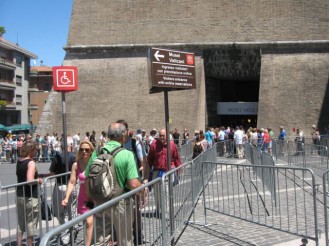
    Info for disabled people: There is no line-up or entrance fee. Just go directly to the main entrance and show your ID. Wheelschairs can be booked in advance.

    Where to buy tickets:

    You can buy entry tickets on line for euro 4.00 more or go directly to the Museum entrance and stand on line. This ticket does not include a tour.

    For more Info: +39 06 69884676 – First you’ll have automatic responses, then if you wish you can talk to an operator.

    No discount tickets are available.

    Should you want a guided tour you can find many tours on line!

    How much do the tickets cost?

    The tickets to the museum cost euro 16.00/person for adults. Reduced tickets cost euro 8.00/person. You can get them at the entrance of the Museum the day you visit.

    Free admission to the Vatican Museums

    Every last Sunday of the month you can enter the Vatican Museums for free from 9.00 AM – 2.00 PM. Last entrance is 12.30 PM. On the 27th of September (World Tourism Day) you’ll have free admission as well! Should one of the following dates fall on a Sunday, another rule will be applied: Easter Sunday,  29th of June and 25th or 26th of December. Be prepared for a long line up!

    Tipp: Book your tickets on-line and save yourself a lot of time! You can also book guided tours through the Vatican Museums.

    When is it best to visit?

    If you visit the Vatican Museum in the afternoon or on a Wednesday, it should be better.

    The most crowded days are Mondays, Saturdays and the last Sunday of the month (because of the free entrance on the last Sunday of every month regulation).

    How to get to the Vatican Museum?

    Metro: Line A – stops: Ottaviano-S.Pietro-Musei Vaticani; Cipro – then 10 minutes by foot

    Bus: Nr. 49 stops right in front of the Museums;  Nr. 32, 81, 982 to Piazza del Risorgimento – then 5 minutes by foot; Nr. 492, 990, Via Leone IV / Via degli Scipioni – then 5 minutes by foot

    Tram Nr. 19 Piazza del Risorgimento – then 5 minutes by foot

    Tip: In Via Santamaura – you will find this Street when walking down the steps next to the Vatican Museum on the other side of the Street – you can find an Internet point and you’ll also be able to make international phone calls and/or print something!

    [/tab]

    [tab name=”Maps”][map id=”87″][/tab][tab name=”Near Attractions”]The Vatican Museum is inside Vatican City. If you walk down the hill along the Vatican walls you will hit Saint Peter’s square which is right in front of Saint Peter’s Basilica. If you walk further down towards the Tiber River, you will see Castel Sant’Angelo and the bridge Ponte Sant’Angelo. 


    [/tab]

    [end_tabset]


  • St Peter’s Square – Vatican City – Rome – Italy

    St Peter’s Square – Vatican City – Rome – Italy

    [tab name=”Information”]

    St Peter’s Square – Vatican City – Rome – Italy

    St Peter’s Square or as the Italians call it Piazza San Pietro is the masterpiece of Gian Lorenzo Bernini done 1657-1667. The Piazza is 240 meters wide. When you stand in the middle of it and look around, you’ll find 284 Doric columns and 88 pilasters of travertine marble surrounding the square! The columns are 13 meters high and are arranged in four rows. There are some spots (white marble discs) on the floor, which are marked on St. Peter’s Square, on which you stand on and you’ll have an optical illusion then you’ll only see 1 row instead of 4!

    The fountains you see on the square have a different history; in 1613 Carlo Maderno built the fountain on the right. Later, Bernini had it erected where it stands now and Carlo Fontana built another fountain in 1675 on the left to give the Piazza a symmetry look!

    The obelisk in the middle of St. Peter’s Square is from the ancient city of Heliopolis on the Nile delta in Egypt (1835 BC). It was brought to Rome by Emperor Caligula for his circus. In 1586 the obelisk was moved to its current position.

    Towards the Basilica on the left side of the square a small red porphyry stone in the pavement marks the spot where Pope John Paul II was shot on the 13th of May in 1981.

    The Pope

    To your left when facing the Basilica you’ll see a building which is the Apostolic Palace. Inside is the Papal apartment which occupies the top floor. The top two right windows are the study and bedroom of the Pope. On Sundays at noon, the pope usually appears at the second window from the right to pray the Angelus and bless the huge crowd waiting for him in the Square! No tickets are required. From around mid-July to mid-September, when it get’s really hot in the city center, the Angelus and blessing take place at the Popes summer residence about 16 miles out of town in a pretty village named Castelgandolfo! The General Audience is held in the Courtyard in the town and even there tickets are not required. Space is limited because of the size of the courtyard!

    Wednesday General Audience held in St Peter’s Square

    At the end of the columns to your right facing the Basilica, you’ll be able to see Bronze Doors used as an entrance to the Apostolic Palace. Swiss Guards always stand here to guard the Palace, but they may be approached by whoever would like to buy tickets which are easily obtained to the Wednesday Papal Audience. Beware: During the Christmas and Easter season it is more difficult! The American church named Santa Susanna can help you further or you can also write a letter to the Vatican: Archbishop James Harvey, Prefect of the Pontifical Household, Vatican City 00120. The Phone number is 0039 06 6988 4857 and the Fax is: 0039 06 6988 5863.

    On the right side on St. Peter’s Square when you come out of the Basilica, immediately you’ll find a Vatican book shop. Further down next to the book shop you’ll have the Post Office. This is where you can get your Vatican stamps which seem to be very appreciated amongst tourists! Right on the square itself they put up another mobile post office because of the long line-ups. A souvenir shop selling religious articles is located next to the post office further down. You’ll pass all of these shops if you like it or not because it’s the way out road after having visited the Basilica! Should you feel sick, a First Aid room is also available down the same path way. Bathrooms for men and women will be located on your right too. A map of the Vatican City has been put up to help tourists find their way around!

    Also, taxi’s are located in the beginning of Via della Conciliazione and St. Peter’s Square.

    If you look to your right facing the basilica when standing next to the crossing Via della Conciliazione and St. Peter’s Square you’ll find the official Vatican tour operators Opera Romana Pellegrinaggi

    [/tab]

    [tab name=”Maps”][mapsmarker marker=”91″][/tab][end_tabset]

  • The Colosseum

    The Colosseum

    [tab name=”Description”]


     The Colosseum, also known as the Flavian Amphitheater


    at Piazza del Colosseo Roma

    The Colosseum in Rome Italy
    The Colosseum in Rome Italy

    The Colosseum, also known as the elliptical amphitheatre was ordered by Emperor Vespasian the founder of the Flavian Dynasty to start construction in 72 AD. His son Titus completed it in 80 AD, the year after Vespasian’s death. After Titus’s untimely death, his younger brother Domitian finished all of the decorative work and built the underground caverns. It is the largest amphitheatre in the world and it is considered one of the greatest works of Roman architecture. It is also one of the seven wonders of the world. The name Colosseum has long been believed to be derived from a giant statue of Nero that stood nearby. It was built on the site of an artificial lake, part of Nero’s huge park in the center of Rome which also included the Golden House – Domus Aurea – and the nearby Colossus statue. The Colosseum is very big measuring at 188m long, 156 wide and reaching a height of more than 159 ft. It had 80 entrances allowing the 55,000 spectators easy access.  To protect the spectators from the sun and rain, they would cover the Colosseum with a giant sail known as the velarium. It was attached to large poles on top of the Colosseum and anchored to the ground by large ropes.
    Emperors used the Colosseum to entertain the public with free games. They held thousands of hand-to-hand combats between gladiators to the death, contests between men and wild animals. The men who fought were prisoners of war, slaves or condemned criminals. They sometimes would flood the arena with water and have mock naval engagements. Part of the structure has fallen into ruin. The southern side of the Colosseum was felled by an earthquake in 847, a great fire destroyed parts of it too. Parts of the building were later used for other construction.

    The Colosseum Ruins are currently under a renovation that is expected to take close to a full year to complete.

    [/tab][tab name=”Maps”] [map id=”45″] [/tab] [tab name=”Important Information”] I would suggest that you go to the Roman Forum right down the street to buy your tickets. You can buy a combo ticket for both the Forum and the Colosseum there and avoid all of the long lines.

    The Colosseum opens its gates at 8.30 AM – 4.00 PM (last entrance). Visiting hours can vary a little during the summer months (longer opening hours). The Colosseum is Closed: 1st of January, 1st of May and 25th of December

    SPECIAL: From the 2nd May to the 2nd November 2013 – every Thursday and Saturday you can participate in special night tours from 8.20 PM until midnight. For info on tours in English you can phone +39/0685301755.

    Info for disabled people: There is an elevator inside. Please ask for assistance at the front ticket center directly at the Colosseum.

    Where to buy tickets: You can buy your tickets in front of the Colosseum at the ticket stand or in Largo Salara Vecchia, 5/6 (Foro Romano) or at the Palatino ticket stand in Via di San Gregorio, 30 (Palatino). NOTE: The tickets you buy to enter the Colosseum are also valid to enter the Foro Romano and the Palatino.

    How much do the tickets cost? For citizens of the European Communion (EC) under 18 and over 65 the ticket is free of charge. For everyone else the admission cost is euro 12. Citizens of the EC aged between 18 – 24 pay euro 7,50. Have your ID card ready. If you have bought an ‘”Archeologia Card”, Roma Pass” or a “Roma&Più Pass card” the entrance for the Colosseum will be included. For more information on these cards and where to get them, have a look under our section “Special Discount Cards for attractions”. I will give you a little trick to avoid lines when getting tickets to enter the Colosseum.  There are 2 lines to buy tickets for the Colosseum, 1 for buying individual tickets and one for tours.  The line for tours is often empty while the line for individuals can seem to be very long.  The tour group line for tickets into the Colosseum is for both guided tours and for people who want to rent an audio tour.  Buying the audio tour will make your wait shorter and also give you a audio guided tour which is all you really need.  The advantage also to buying your tour ticket is it is also good for the Palatine Hill in the Roman Forum eliminating the need to stand in line a second time to buy tickets. If you do choose to stay in line you will have more than enough going on around you to keep you entertained.  There are actors dressed up in gladiator outfits and plenty of other tourists to talk to. How to get there: Opening hours: The simplest way to get to the Colosseum is with the Metro, considering that you don’t want to walk over or take a taxi from wherever you are. The Colosseum is not out of reach from the other attractions, so you could consider walking. If you decide to take the Metro, you’ll be taking the B line (Laurentina direction) and getting off at the Colosseo Metro Station. All these buses go to the Colosseum as well: 60 – 75 – 85 – 87 – 117 – 271 – 571 – 175 – 186 – 810 – 850 – C3 as well as the Tram 3. My favorite possibility would be the “Hop on – Hop off” bus that takes you around to the main attractions for euro 20/day or euro 25 for 2 days. By the way, for a couple of euro’s more you can get a deal for the Tiber River Cruise.

    Souvenirs and Shopping at the Colosseum There are some great gift shops inside the Colosseum and several shops outside also. Hot tip for all photographers: you’ll get the best pictures from standing on a bridge in Via degli Annibaldi. It’s the street where the hop on-hop off buses stop, only a little further down walking away from the Colosseum. You’ll get fantastic pictures without any tourist heads! Have a look at our picture where it is!

    From this bridge you’ll get the best pictures!

    Where to Eat when you visit the Colosseum During your visit you will see many street side cafe’s, sit down restaurants and pizzerias to choose from. [/tab][end_tabset]

  • Roman Forum

    Roman Forum

    The Roman Forum Rome Italy

    The Roman Forum

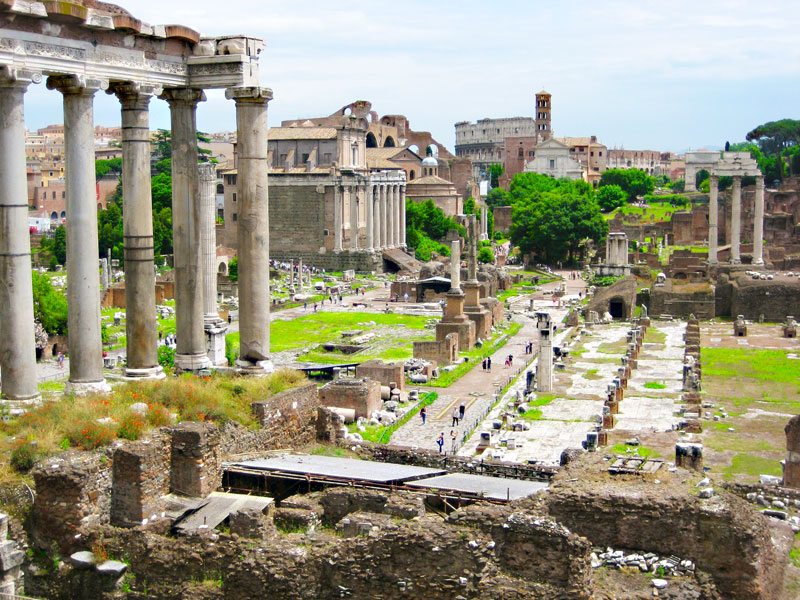
    [tab name=”History of The Roman Forum”]The Roman Forum is situated in a valley between the Palatine and the Capitol.

    It was first developed in the 7th century BC and expanded over centuries.

    The area was a marsh, so the Romans built a sewer to drain water. They made it into a center of political and social activity. It was the business district and marketplace of Rome. Over time it was expanded and they built temples, a senate house and a court of law. When the Roman Empire fell, the Forum eventually became a forgotten place. It was buried and used as a cattle pasture during the middle ages.

    Like a lot of other ancient Roman buildings, stone blocks have been taken from the Forum and used to build churches and other buildings. The arch of Septimius Severus and the arch of Titus are still standing. There are some columns and stone blocks from the temples that remain.

    The arch of Titus was built in 81 A.D to honor Titus the emperor that had sacked the great Jewish temple in Jerusalem. The arch of Septimius Severus is located at the opposite end of the forum; it was built in 203 A.D to honor Septimius Severus and his two sons, Caracalla and Geta who fought with him in the war.

    Titus Larcius built the temple of Saturn in 17 B.C.; it was used as the public treasury. They expanded the building in 42 B.C., after a fire in the 4th century A.D. they rebuilt it. Today eight columns remain of this temple.

    The Basilica of Maxentius was built in the 4th century and used as Rome’s public law courts. Maxentius began the construction and was completed by Constantine. Some of the structure has been restored.

    The temple of Antoninus and Faustina was built in 141 AD, Emperor Antonius Pius had this built to honor his wife Faustina after she died. During the Middle Ages it was turned into the church of “San Lorenzo in Miranda” Today this temple is the best-preserved building in the Forum.

    The Curia was the Roman Senate building and was constructed by Tullus Hostilius.
    It is the largest brick building in the Forum. It still has a roof and the original marble floor inside.

    The Rostra was a speaker’s platform originally built in the fourth century B.C. Caesar had the Rostra rebuilt in marble at the location it stands now.

    There are other shrines and several more structures can be found at the Forum.

    I really loved the Roman Forum. It’s a large area and history is everywhere for you to explore and marvel at. You shouldn’t miss this if you are in Rome. It’s just breathtaking and if you love history, you will not be disappointed.

    [/tab]
    [tab name=”Maps “] [map id=”20″] [/tab]
    [tab name=”Important Information”]Make sure you wear very good walking shoes. If visiting on a hot day, bring a hat since there isn’t a lot of shade and the sun tends to bake this site.

    Address: Via della Salaria Vecchia, 5/6, Rome, Italy

    Phone number: +39 06 0608

    Hours: Monday through Sunday 8:30 am – 4:30 pm

    [/tab]
    [end_tabset]

  • Church Santa Maria del Popolo Rome

    Church Santa Maria del Popolo Rome

    [tab name=”Description”]

    Church Santa Maria del Popolo Rome

    Church Santa Maria del Popolo is situated on the north side of Piazza del Popolo. It is between Porta del Popolo and the Pincio hill. It is also very close walking distance from the Flamini Metro station.

    This is a beautiful and stunning church to visit with some incredible architecture to see.


    Andrea Bregno designed the Church Santa Maria del Popolo. It was built in 1477. The church houses many noteworthy works of art. It includes Rome’s oldest stained-glass windows made by French artist Guillaume de Marcillat. Unfortunately it is not accessible but you can see it behind the high alter.

    Enjoy the amazing artwork from several famous artists, architects and sculptors. Including Raphael, Gian Lorenzo Bernini, Caravaggio, Pinturicchio, Andrea Bregno, Guillaume de Marcillat and Donato Bramante. There are two famous paintings by Caravaggio. In the Cerasi chapel is where will you find ‘The Crucifixion of Saint Peter’ and ‘The Conversion of Saul’. The sheer physicality of the figures is quite breathtaking. The paintings are in a no photo zone in the church. You have to deposit coins to activate the lights to view them. However there are a few Bernini sculptures that are well lit and you are able to take pictures of them.

    In the first chapel on the right, you can see some wondrous frescoes by Pinturicchio from the mid-15th century

    The Chigi Chapel, just on the left when you enter the church. It has mosaic-decorated panels between gold painted stuccos. It was designed by Raphael and completed by Bernini. He included the sculptures Habakkuk and the Angel and Daniel and the Lion. Of course, anyone who’s read Angels & Demons by Dan Brown knows this sculpture is the first marker, with the Angel in the statue pointing the way to the next clue. It was amazing to see, it won’t disappoint you.

    The tombs of Cardinals Ascanio Sforza and Girolamo Basso della Rovere can also be found in the apse.

    There’s a chilling skeleton mosaic on the floor of the chapel. It is known as the ‘demon’s hole’. There are effigies in the floor of brass bones and skulls. A grim reaper mosaics, a caged skeleton in the wall to the left as you enter.

    Church Santa Maria del Popolo often goes unnoticed because of its unassuming location and its rather simple Baroque style facade by Bernini.

    Overall, the Church Santa Maria del Popolo is a marvelous church to visit.

    After visiting this church, you can visit the delightful Piazza del Popolo. See the impressive very old obelisk fountains found on the east and west ends of the square. Also go and check the two ‘twin’ churches (Santa Maria dei Miracoli and Santa Maria di Montesanto) on the south side of the piazza.[/tab]

    [tab name=”Maps”] [map id=”154″] [/tab]
    [tab name=”Information”]

    Phone number: +39 06 361 0836

    Address: Piazza del Popolo, 12, 00187 Rome, Italy

    The church is open daily from 7am to 12pm, 4pm to 7pm, except Sunday & Holy Days of Obligation from 8am to 1:30pm and 4:30pm to 7:30pm.

    Admission is free. When entering you need to be mindful of the shoulders and knees being covered.[/tab][tab name=”Nearby Attractions”] The church lies on Piazza del Popolo. When you walk up the stairs towards the Pincio you are very near to: Villa Borghese Park, Galleria Borghese and Bioparco di Roma (zoo). 

    If you cross the Villa Borghese Park you’ll hit the Roman Walls and Via Veneto.

    Via del Corso connects with Piazza del Popolo, where Church Santa Maria del Popolo stands, and if you walk straight down it you’ll reach Piazza Venezia and it’s nearby attractions.

    If you stop half way when in Via del Corso, you can visit the Spanish Steps and the Trevi fountain. From Via del Corso you can also walk towards the Pantheon.

    [/tab][end_tabset]

  • Church of St Mary of the Angels and the Martyrs

    Church of St Mary of the Angels and the Martyrs

    [tab name=”Description”]

    Church of St Mary of the Angels and the Martyrs

    Church of St Mary of the Angels and the Martyrs is conveniently located close to the National Museum of Rome and the Termini station. You can also catch Hop On, Hop Off buses from this area. The church faces onto Piazza Repubblica that is at the top end of Via Nazionale.

    The outside of the Church of St Mary of the Angels and the Martyrs looks very unassuming. There is no true facade; in fact it matches the ruins of the adjacent (and partial incorporated) Roman baths. Walk through those huge bronze doors and then you see this Basilicas inner beauty.

    Michelangelo designed this immense and beautiful church on the remains of the Baths of Diocletian at the request of Pope Pius IV in 1561. The baths were enormous and still has a lot of the original structure. It could accommodate over three thousand bathers at the same time. Try to imagine what was going on here with all the original Romans bathing here.

    Church of St Mary of the Angels and the Martyrs is awe-inspiring with its huge stained glass dome, extraordinary arches and appealing baroque detail. It’s not as ornate (in comparison with other churches in Rome), but its simplicity adds to its grandeur. It was stunning when the sun pours through the windows. The multi-colored tile gleams. The artwork and architecture is intricate, exquisite and majestic.

    One of its most interesting features is further inside the church. It is a strip of inlaid numbers and zodiac symbols on the floor. It is a sundial/calendar and was built in 1702.

    There is a notch cut out of the right transept for a fine ray of sunlight. It shines down on the line and moves across it as the day continues.

    Church of St Mary of the Angels and the Martyrs has a very large and beautiful pipe organ that plays unbelievable music. I was lucky to be here when the choir was practicing and they were using the pipe organ. It just sounds so graceful.

    Also remember to go towards the left of the main chapel into the small chapel where exhibits are held. The large bronze statue of Galileo was spectacular. It is placed around the towering outer structure of the original Diocletian Baths, with original planks of marble poking out of the worn red bricks. In order to read the exhibit, you have to put Euro coins into the machine to turn on the light.

    The church was not crammed with tourists. I promise you won’t be disappointed with this relatively little known and little-visited church. It is truly a beautiful church.[/tab]

    [tab name=”Maps”] [map id=”153″] [/tab]
    [tab name=”Information”]

    Phone number: +39 06 488 0812

    Address: Piazza della Repubblica, Rome, Italy

    Be sure to dress respectfully, knees and shoulders have to be covered. There is usually someone checking visitors at the door.[/tab][tab name=”Nearby Attractions”]Piazza della Repubblica, Museo Nazionale Romano, Via Nazionale and Termini train station are very close together. Basilica di Santa Maria Maggiore is also in that area, even though it’s a little further away than the other mentioned attractions.

     [/tab][end_tabset]


  • Roman Walls

    Roman Walls

    [tab name=”Description”]

    Roman Walls

    Roman Walls was constructed in the 6th century BC. It was to prevent a repeat of the sack of Rome during Battle of the Allia by the Gauls of Brennus. Roman Walls were still standing in the end of the Republic and the early Empire. By then Rome had begun to expand outside the wall. Rome continued to grow and thrive. And as the military grew and got stronger the Roman Walls became unwarranted.

    Roman Walls were built from monstrous blocks of tufa. Tufa consists of volcanic rock made from ash and rock particles spewed out during an eruption.

    Most of the Roman Walls did not endure the time since it was built. Parts of the Roman walls can be seen around the city. Perhaps your first view being on the train arriving from the airport near the entrance of the Termini station. Another notable section is at the end of Via Veneto as you approach the Villa Borghese. You can see small sections as you pass Piazza Magnanapoli just above Trajan’s Forum. My favorite segment was when I took a stroll up the Aventine to visit the church of Santa Sabina and the other basilicas on the hill.[/tab][tab name=”Nearby Attractions”] Near the Roman walls which you see next to Via Veneto, you can then visit Via Veneto directly. If you cross the street you’ll walk straight inside Villa Borghese Park and if you walk further you’ll see Galleria Borghese and then the Bioparco (zoo).

    If you stay on Via Veneto and walk down the road, you’ll hit the Church Santa Maria della Concezione on your left hand side and then Piazza Barberini, which has the Triton fountain standing in the middle of it. If you turn the corner to your left hand side, you’ll see Barberini Palace.

    [/tab][end_tabset]

  • Holy Stairs Piazza di San Giovanni in Laterano

    Holy Stairs Piazza di San Giovanni in Laterano

    [tab name=”Description”]

    Holy Stairs

    Holy Stairs or Scala Santa is right across the street from the Cathedral of St. John Lateran. The best way to get there is with the Metro A – San Giovanni stop or with the Hop on hop off bus Roma Cristiana.

    According to the Catholic tradition, Christ walked up these steps as he was condemned to death by crucifixion. These steps were brought from Jerusalem to Rome in the 4th century by St Helena, the mother of emperor Constantine and placed in this church.

    Tradition dictates that you must ascend the Holy Stairs on your knees. There are 28 of them. They’re covered in wood, with cut outs on the risers where you may touch the stairs. There are some small areas covered in glass with the bloodstains of Christ.

    I loved the experience of climbing the steps on my knees. To climb the steps as Jesus did is an emotional and humbling experience. Your knees begin to hurt, but just think of the pain that Jesus went through carrying a cross and bearing the pain of being beaten. Then you can manage the few moments of pain from crawling up the steps I would definitely recommend making the climb. When you reach the top of the Holy Stairs you can visit Sancta Sanctorum (Holy of Holies). It was the personal chapel of the early Popes. There are some beautiful frescoes. What I loved the most was the display in a glass case. It housed the fragment of the table on which the Last Supper was served.

    I feel this is the ultimate must do if you visit Rome. It’s so inspiring and you get a great feeling of accomplishment afterwards. It was worth it to me. I went early morning and it was almost empty.[/tab]

    [tab name=”Maps”] [map id=”152″] [/tab][tab name=”Nearby Attractions”]Cathedral of St. John Lateran is right across the street.

    [/tab] [tab name=”Address”]Piazza di San Giovanni in Laterano, 14, 00184 Rome, Italy[/tab]

    [end_tabset]

  • Vittorio Emmanuel II Monument Rome

    Vittorio Emmanuel II Monument Rome

    [tab name=”Description”]

    Vittorio Emmanuel II Monument Rome

    Vittorio Emmanuel II Monument is a massive building made of white marble situated at the point where Piazza Venezia meets the Capitoline Hill.


    This monument was built to honor Victor Emmanuel II, the first king of a unified Italy. Giuseppe Sacconi designed Vittorio Emmanuel II Monument in 1895. It was inaugurated in 1911 and completed in 1925. They built this monument with pure white marble from Botticino, the province of Brescia.


    This imposing and beautiful landmark has been a controversial building since the beginning of construction for a few reasons. Many people said it was too white and way too big. They were also angry because construction destroyed a large area of the Capitoline Hill. Many locals have dubbed the Vittorio Emmanuel II Monument as the wedding cake and the Victorian typewriter.


    It features majestic stairways, tall Corinthian columns and fountains. In the middle of the two sets of steps to the monument is an equestrian statue of Victor Emmanuel. Two fountains that represent the Tyrrhenian Sea are on either side of the monument. At the top of the monument are two quadrigas representing Liberty and Unity.


    Please know that sitting on the steps at the entrance is forbidden. There is a guard that will blow his whistle if you attempt to take a seat.
    An eternal flame guarded by soldiers burns on this front terrace to mark the grave of an unknown soldier from WW I. There are two soldiers standing here 24/7, holding a lance in the hand and wearing a black beret.


    Inside the Vittorio Emmanuel II Monument there is a free museum. The museum is dedicated to the World War I. In the middle of the room, is the gun carriage used in 1921 for transporting the remains of the Unknown solder. Outside the museum is a terrace and café with wonderful views of Rome. There is free access to the terrace.

    However there is glass elevator at the back of the Vittorio Emmanuel II Monument. This takes you to the very top. It’s a superb opportunity to embrace and take some photos of the Eternal City. When I was visiting there was quite a line for the elevator. There is a seven Euro charge, but I consider it well worth it for a one-time visit. You can also take the stairs all the way up, but I don’t recommend that option unless you are in fantastic shape.

    Behind the monument are the Roman Forum and the Coliseum. In front of it is Via Corso, which in turn has the Trevi Fountain and The Spanish Steps to the right. The Vatican and Piazza Novona are to the left. Church of Santa Maria in Aracoelli is situated up against this monument. Upon exiting the Vittorio Emmanuel II Monument you can go into the church with the high staircase next to the Capitoline Museum, without climbing the steps.

    [/tab]

    [tab name=”Maps”] [map id=”142″] [/tab]

    [tab name=”Information”]

    Phone number: +39 06 678 0664

    Address: Piazza Venezia, 00186 Rome, Italy

    Hours: Monday through Friday, 9:30 am – 5:30 pm

    Saturday and Sunday, Closed[/tab][tab name=”Nearby Attractions”]Via del Corso, Piazza Venezia, Le Domus Romane di Palazzo Valetini

    Further down the road you’ll find the Colosseum[/tab][end_tabset]

  • Spanish Steps Rome

    Spanish Steps Rome

    [tab name=”Description”]

    Spanish Steps Rome

    Spanish Steps is a great landmark and is definitely worth seeing. It is located within walking distance of other major Rome landmarks, such as the Fontana di Trevi, the Pantheon, and St. Peter’s Basilica.

    The Spanish Steps was built in honor of a diplomatic visit by the king of Spain.

    Architect Francesco de Sanctis designed the steps. Construction began in 1723 and was completed in 1725.

    The staircase is divided by three landings and has beautiful flowers aligning the steps.  The steps are abuzz with people talking, sitting and take some photos. I recommend grabbing a sandwich or gelato and eating it on the steps while you take in the amazing sights around you. The Spanish Steps gets crowded, but it is worth a quick stop at this iconic spot.

    At the top of the Spanish Steps, you get a picturesque view of Rome in all its beauty. At the top of the staircase there is the glorious Trinitá dei Monti church. There are some lovely paintings inside and the view from out front is breathtaking.

    Bernini “Fountain of the Old Boat” is situated in the Piazza di Spagna at the base of the magnificent Spanish Steps. The fountain was commissioned by Pope Urban VIII and was built by Pietro Bernini and his son. This beautiful fountain depicts an old boat and was brought forward by the area during the flood of the Tiber.

    At the foot of the staircase is a house where the well-known English Romantic poet John Keats lived. The museum is dedicated to his memory. The Column of Immaculate Conception is also close by and honors dogmas of Christianity.

    At the bottom of the steps there are horse and carriage rides available that will make it top this pleasant experience. The designer shops neighboring the Spanish Steps allows for some amazing window-shopping!

    Please keep an eye out the scam artists in the area. These peddlers like to try and take advantage of women and couples by handing roses to them for “free”. Once they put the rose in your hand they then demand a payment. Other men will approach and try to engage you in friendly conversation. They will tie a “friendship” string around your wrist. And then when they are done make this bracelet they will demand of 20-25 euros. Just keep your hands in your pockets so they don’t have the opportunity to attempt the scams. Just tell them no and keep moving.


    [/tab]

    [tab name=”Maps”] [map id=”141″] [/tab]

    [tab name=”Information”]

    Address: Via dei Condotti, Rome, Italy

    The closest Metro stop is Spagna, which is right under the Spanish Steps. [/tab][tab name=”Nearby Attractions”]Via del Corso, Piazza del Popolo and Trevi Fountain are all near the Spanish Steps, whereby Piazza del Popolo and Trevi Fountain run in opposite directions when walking from the Spanish steps. A little further away you can find the Pantheon which is about a 20 minute comfortable walk through the narrow streets of the city centre.


    If you walk down Via del Corso and arrive at Piazza Venezia, it’ll take about 15 – 20 minutes if you don’t stop and look at the windows. From Piazza Venezia you can start visiting Vittorio Emanuel II Monument and many more attractions which are located in that area.

    [/tab][end_tabset]

  • Capitoline Hill Rome

    Capitoline Hill Rome

    [tab name=”Description”]

    Capitoline Hill Rome

    The Capitoline Hill is the most famous of the Seven Hills of Rome. It is the smallest of the Seven Hills of Rome. Throughout ancient times, Capitoline Hill had numerous temples facing toward the Roman Forum.

    Legend claims that Rome was founded on Capitoline Hill by Romulus in 753 B.C. Romulus and his brother, Remus, were the kids of the god Mars and Silvia. She was the princess of Alba Longa who had been forced to be a vestal. The king of Alba Longa, the uncle of Romulus and Remus, aimed to kill them. However Silvia left them to fend for themselves, in the hopes that they would live. According to the legend, they were cared by a she-wolf, who nurtured them. Many years later Romulus brought together outlaws to attack the Sabine and kidnap their women and by doing so founded Rome.

    The top of the Capitoline Hill was where ancient Romans built the Temple of Jupiter. Today the Municipality of Rome and the Capitoline Museums are located in the twin palaces flanking the plaza. If you visit here you will see some amazing views of the Forum. Michelangelo designed the Piazza del Campidoglio, the stairs and the surrounding buildings. He built it with perfect symmetry; they faced the Basilica di San Pietro. There is a statue of emperor Marcus Aurelius on horseback in center of Piazza. The stairs were built so they could be ridden up horseback without dismounting. The steps are a bit daunting. However you should make the trip up as the views of Rome from the top are well worth the climb. The most noteworthy landmark is the Capitoline Wolf bronze statue that has a very strong historical background. Behind the museum is the Tarpeian rock. It provides a spectacular view of the Roman Forum. Close by you can also find the Palazzo Venezia, which was the former residence of Mussolini.

    The view of the Imperial Fora is breathtaking, also the Caesar’s Forum on the side. Also what is visible in the Roman Forum is the Arch of Septimius Severus and Temple of Saturn. While you are visiting the Capitoline Hill, you really to get relish one of the most beautiful panoramas in Europe archaeological Capitoline Hill. [/tab]

    [tab name=”Maps”] [map id=”147″] [/tab]

    [tab name=”Information”]

    Phone number: +39 06 0608

    Address: Piazza del Campidoglio, Rome, Italy[/tab][end_tabset]

  • Forum of Augustus Rome

    Forum of Augustus Rome

    [tab name=”Description”]

    Forum of Augustus Rome

    The Forum of Augustus is one of the Imperial forums of Rome, Italy. It was built by Augustus is across from the Forum of Julius Caesar. The statue of Augustus stands before the ruins of his forum.

    They aren’t open all the time and it’s better to check before if you can go inside and visit. If they are open you have to buy tickets in advance. If not, you can have a look at them from the outside when walking down the street Via dei Fori Imperiali.

    During the battle of Philippi in 42 BC, Octavian (Augustus) promised to build a temple dedicating Mars, the Roman God of War. After the battle he avenged the assassination of his adoptive father Julius Caesar. Later he became the first emperor of Rome in 27 BC. He changed his name to Augustus, and arranged for the temple to be built in a new forum named after him.

    The Forum of Augustus included an open plaza lined on its long sides by colonnades off of which hemicycles opened on the northern ends. The back wall of the colonnades had niches in which were set statues of famous republican leaders as well as Augustus’ own ancestors. Inscriptions below the statues showed the highlights of the leaders career. An enormous statue of the Genius of Augustus governed a room decorated with colored marbles at the end of one of the colonnades. The northeastern end of the plaza includes the Temple of Mars Ultor. It was devoted to the war god in his appearance as the avenger of the assassination of Julius Caesar, Augustus’ great uncle and adoptive father. A great wall stood behind the temple and divided the forum from the noisy lower-class residential area known as the Suburra.

    Remember to take a map of the site with you. It will help you identify the ruins. The best part for me were the arches and the Curia, former home of the Senate. You need to be careful because it is very dark inside to help preserve the interior. Once inside you’ll see some beautiful mosaic tiled floors and wall mosaics.

    As I walked through the Forum of Augustus as the sun was setting. I was amazed at the architecture and history this mystical place held. To stand and see the huge stone buildings and pillars that were built without modern mechanical means is impressive.

    If you visit Palatine Hill, you can enter the Forum of Augustus directly without reentering any lines outside. Walk down the original stone path. You’ll be facing in the direction of the Coliseum on this path and enter the Forum by the Arch of Titus.

    Forum of Augustus is located in front of the Colosseum and the Roman Forum. It is close to Trajan’s Market, Trajan’s Column, and the Forum of Nerva.[/tab]

    [tab name=”Maps”] [map id=”146″] [/tab]
    [tab name=”Information”]
    Address: Via dei Fori Imperiali, Rome, Italy

    Call: +39 060608 and press 2 for english. You can ask if they’ll be open and also buy tickets.[/tab][end_tabset]

  • Capitoline Museums Rome

    Capitoline Museums Rome

    [tab name=”Description”]

    Capitoline Museums Rome

    Capitoline Museums is easy walking distance from the Colosseum. It is situated in front of Rome’s present-day City Hall, very close to the Roman Forum and the Victor Emmanuel monument.

    Capitoline Museums is one of the oldest museums in the world. It’s an astonishing place when you can easily spend several hours reflecting on impressive sculptures, paintings and mosaics from imperial Roman times.

    The history of the museums goes back to Pope Sixtus IV. In 1471 he donated a collection of important ancient bronzes that had great symbolic value to the city of Rome.

    Pope Clement XII had it open to the public in 1734, making them the first museums in the world open to the public.

    These two Renaissance buildings face each other on a majestic square. None other than Michelangelo himself designed it in 1536. It was completed over a period of more than 400 years.

    In the courtyard you will see the huge head, hand & foot of Constantine. A statue of a mounted rider in the middle of the piazza is of Emperor Marcus Aurelius. That one is the replica, the authentic statue is inside.

    Many sensational paintings can be seen here. There are Veronese, Tintoretto, Caravaggio and Van Dyck and many more. My favorite two are Caravaggio’s Fortune Teller and John the Baptist.

    I was also overwhelmed by the beauty and grandeur of the many sculptures on display.

    Capitoline Wolf with Romulus and Remus is one my favorite pieces of art in the Capitoline Museums. I also love Spinario (boy extracting a thorn out of his foot), Bernini’s Medusa and the Dying Gaul the sad image of a warrior who is dying.

    Don’t forget to see the room with the 65 busts of the Roman emperors. The one of Marcus Aurelius is something I never tire of seeing.

    To get from one wing to the other do not go exit the building. You have to take the underground passage linking the two buildings. Down in the tunnel contains some burial headstones and signs that give you an insight into Roman lives. My favorite was the gravestones of a chariot racer. There is a cafe on site as well; it has good value lunches and coffee.  The view of the city from this cafe is breathtaking.

    You have to drop off your bags at the locker room before you enter. The fee for storage is 1 euro, but is refunded when you return the key.

    You can take photos without a flash in some parts of the Capitoline Museums but not in special exhibits. There is a lot to see and I would plan to allow 3 – 4 hours to actually look around.[/tab]

    [tab name=”Maps”] [map id=”123″] [/tab]
    [tab name=”Information”]

    Phone number: +39 06 0608

    Address: Piazza del Campidoglio, 1, 00186 Rome, Italy

    Hours: Monday Closed

    Tuesday through Sunday, 9:00 am – 8:00 pm

    Last admission 1 hour before closing time.[/tab][end_tabset]


  • Mouth of Truth Rome

    Mouth of Truth Rome

    Mouth of Truth Rome

    [tab name=”Description”]The Mouth of Truth is the most famous attraction of Santa Maria in Cosmedin, a basilica in Rome. A face carved in marble, most likely that of the pagan god Oceanus, was made famous in the film Roman Holiday starring Audrey Hepburn and Gregory Peck.

    The myth of the Mouth of Truth began in the medieval times. The Romans would test a person they believed to be lying or committing adultery by bringing them to the marble face. They were told to tell the truth and then put their hand into the mouth. If the person were lying, the hand would have been taken off.

    Some say it was also used during the Middle Ages as a trial by ordeal. They would place an executioner behind the large stone face with a sharp sword ready to cut off the hand.

    Some people also say a rich wife of a Roman noble was accused of adultery. The wife denied the accusations, however the husband demanded that she place her hand inside the stone mouth. The wife knew perfectly well that she was guilty came up with a strategy. A large group of bystanders who had gathered around the “Mouth of Truth”, witnessed a man who was actually her lover ran up to her and kissed her. The wife played along saying she didn’t know the madman and the people in the crowd chased him away. When she place her hand into the mouth, the woman said that she had never kissed any other man apart from her husband and the madman who had just kissed her. Therefore she wasn’t lying and her hand was saved. The betrayed husband saved her honor, but the “Mouth of Truth” upset by the trickery hasn’t worked since that incident.

    Some historians believe the round sculpture was either used as manhole cover or part of another fountain that was then taken apart. Another theory is it was used as a drain cover in the nearby Temple of Hercules that had an open space in the middle of the roof just as the Pantheon has today.

    It’s a massive marble stone with the dimensions of 1,75 m x 1,75 m x 19 cm and which weighs around 1300 Kg. Carved in the 4th century B.C.

    Just a stone throw away from the “Mouth of Truth” you can see the Arch of Janus, the Temple of Hercules Olivarius, the Fountain of the Tritons and the Temple of Portunus.

    The Mouth of Truth Rome lies inside the portico of the stunning Paleochristian church of Santa Maria in Cosmedin since the 13th century, later in the 17th century the disc was moved to its current location. The church is renowned for its beautiful Cosmatesque artwork and it’s unique bell tower. The church is dedicated to the Virgin Mary and was originally looked after by Greek monks.

    [/tab]
    [tab name=”Maps”] [map id=”102″] [/tab]
    [tab name=”Price”]The entrance is free of charge. However there’s a cameraman standing next to the “Mouth of Truth”, he will take a picture of you for a voluntary donation of 0.50 cents. Hours: Daily from 10.00 AM to 5.00 PM[/tab][tab name=”Directions”]How to get there: Metro: B Line: Circo Massimo – then walk down 300 meters Via Dei Cerchi or Via Del Circo Massimo

    Bus: N° 95, 160, 170, 44, 716 and 781
    Address: Via della Greca, 4, Rome, Italy

    [/tab]
    [tab name=”Tips”]Very Important: Please remember if you want to also visit the church, there is a dress code: no pants or skirts over your knee allowed entrance.

    The gate to the portico and access to the Mouth of Truth closes 10 minutes before the church.

    [/tab]

    [tab name=”Nearby Attractions”]

    From the Mouth of Truth Attraction you can cross the Garibaldi bridge and you’ll get to the Trastevere area. The structure you see on the Island is a hospital called Fatebenefratelli. During your visit in the Trastevere area, you can see one of Romes oldest churches called Santa Maria in Trastevere.

    From the Mouth of Truth attraction you can also go and visit Circus Maximus which is only a couple of 100 meters away. The Baths of Caracalla are also in that corner, even though they are a little further away (around 2 km).

    [/tab]

    [end_tabset]

  • Villa Borghese Rome

    Villa Borghese Rome

    [tab name=”Description”]

    Villa Borghese Rome

    Villa Borghese, Piazzale Napoleone Rome. Enjoy a relaxing stroll through the Borghese gardens.

    Villa Borghese is a large landscape garden in the naturalistic English manner in Rome, containing a number of buildings, museums and attractions. It is the second largest public park in Rome after that of the Villa Doria Pamphili.

    Villa Borghese Rome park has two main entrances; one is at the Piazzale Flaminio, near Piazza del Popolo, and the other entrance is Porta Pinciana at the end of the Via Veneto. You can also enter the park in Piazzale S. Paolo del Brasile, Via Raimondi and Via di Valle Giulia.

    Villa Borghese Rome was originally a vineyard in the 16th century when in 1605 cardinal Scipione Borghese turned it into a park. Then, for the very first time the landscaper Domenico Savino da Montepulciano designed a very simple outlined park with geometric shapes. After, the architect Flaminio Ponzio built a villa from sketches which were made from the cardinal Scipione Borghese himself!

    In the 18th century an artificial lake was added and in 1903 the city of Rome received Villa Borghese from the Borghese family and finally opened this beautiful park to the public!

    It’s opening hours are from Monday – Sunday from 8.00AM – 7.00PM

    What can you expect to see when strolling in the Villa Borghese park?

    Villa Borghese museums in Rome

    Villa Borghese is also known as the park of Museums. The most famous one is the Borghese Gallery Piazzale Museo Borghese, 5 – 00197 Rome where you can admire paintings, sculptures and antiquities from famous artists like Antonello da Messina, Giovanni Bellini, Raffaello, Tiziano, Correggio and Caravaggio. Ask your hotel to provide you with the tickets or get them yourself directly on the internet. Check some days before you’d like to go because it could be they’re sold out! The price is euro 13.00/person, EU citizens and EU teachers get a discount. To get inside the Borghese Gallery you must make a reservation. Entrance is permitted up to half an hour before the closing of the Gallery.

    Either when you’re finished with your tour of the Museum; before you come out or taking a separate entrance to your left when standing in front and looking at the Borghese Museum, you’ll find a Cafeteria and Bookshop belonging to the structure. You can have a coffee, grab a sandwich/croissant or buy some interesting small souvenirs!

    Opening hours: From Tuesday to Sunday: from 8.00AM to 7.30PM

    Closed:  on Mondays, 1st of January and 25th December

    Phone: +39 06 841 3979

    Address: Via Aldrovandi 00197 Roma Italy

    The Galleria Nazionale d’Arte Moderna which is located on the grounds of the” 1911 World Exposition” could also be worth a visit. The museum holds a collection of 19th and 20th century paintings, mostly done by Italian artists. Last but not least, you can also visit the Museo Nazionale Etrusco. It displays a collection of pre-Roman objects, mostly Etruscan, uncovered around Rome.

    During your promenade you’ll be able to see several temples, divine fountains and numberless statues. Villa Borghese also holds an amphitheater called “ Piazza di Siena”, an 18th century arch “ arco di Settimio Severo” and a graceful botanical garden.

    On the weekends, you can often see skate-boarders and roller bladders doing
    amazing stunts on one of the straight stretches of the passageway. Many musicians come here to perform so you’re welcome to have a seat on one of the many benches or lie in the green grass with your picnic lunch and enjoy!

    Fun things to do in Villa Borghese with kids

    If you have kids, I would recommend you to come in from the end of Via Veneto because you’ll find the main attractions like rides, the playground or bikes for them without having to walk too far. There is also a train that starts from there and which will take you to the other side of the park where the Borghese Gallery is. Another good place to come in should you have kids is the Pincio from Piazza del Popolo. You’ll find rides, go-karts, bikes, restaurants and more. Should you go during the weekend you’ll probably find some pony’s to ride! Also, if you should be able to understand Italian, there’s a puppet house with shows twice daily. They also sell hand-made puppets for euro 13.00/each!

    You can rent bikes, segways, golf carts and boats for yourself and your family. Kids will simply love it!  Kids can also have fun on rides or in play areas which are not easy to find around town. The zoo is right next to the park if you have more time and you’re up to it. There are also signs for a cafeteria named “Caffe del Prado” which is part of the zoo. That’s why you’ll have to pay to get into!

    [/tab]

    [tab name=”Maps”][map id=”84″][/tab]

    [tab name=”Information”]

    Parking

    If you’re bringing your car with you to the eternal city, parking will be very difficult. Right beside Villa Borghese you’ll find covered parking spaces in a parking complex called Villa Borghese – Viale del Galoppatoio, 33 – Roma – 197. From there you can also reach the city center by foot!

    How to reach Villa Borghese:

    With the metro: getting off at the metro stations Flaminio or Spagna

    Tram: tram Nr. 2 getting off the Flaminia station, tram Nr. 3 and 19 getting off the Thorvaldsen, Bioparco and Aldrovandi station. [/tab][tab name=”Nearby Attractions”]Via Veneto and the Roman walls are right next to the exit of Villa Borghese Park.

    Galleria Borghese and Bioparco (zoo) are inside Villa Borghese.

    You can find Piazza del Popolo and Church Santa Maria del Popolo right underneath the Pincio when walking downwards from Villa Borghese Park.

    [/tab][end_tabset]


  • Galleria Borghese Rome

    Galleria Borghese Rome

    [tab name=”Description”]

    Galleria Borghese Rome

    Galleria Borghese houses many exquisite items that are set in elegantly decorated rooms in the one-time home of the Borghese family. It consists of twenty rooms across two floors. Between 1613 and 1615, Architect Flaminio Ponzio built the Villa Borghese for the Cardinal Scipione Borghese the nephew of Pope Paul V.

    Walking into the entrance hall you will see with beautiful 4th-century floor mosaics of fighting gladiators. Look up and see Mariano Rossi’s brilliant fresco of Jupiter shining down on Romulus and Remus, the Capitoline Geese, the River Tiber, the Tiburtine Sibyl and others.

    The main floor is mostly dedicated to intricate Roman floor mosaics, classical antiques of the 1st and 3rd centuries AD and classical and neo-classical sculptures. The other spaces are devoted to European Renaissance paintings. The paintings in Galleria Borghese are just breathtaking. It has some of the best including some by Caravaggio, Botticelli and Raphael and many others.

    My favorite has to be Raphael’s painting. The Deposition also known as The Entombment, tells the story of the final days of Jesus Christ. I was very moved by the people carrying Christ. The Virgin Mary is also there, as she is being held after seeming to have fainted.

    The sculptures are incredible, they will absolutely blow you away. I can’t believe they were made from marble.

    Galleria Borghese Rome has many sculptures displayed here. My two favorite sculptures of Bernini are here. Apollo and Daphne. Where Daphne is turning into a tree before your very eyes, as Apollo is about to catch her and have his way with her. The other one is David with the Slingshot. David is stretching his sling as he eyes up Goliath. They are some of the most realistic depictions of the human form I’ve ever seen. Everything from the muscles to the look on his face is perfectly carved in marble.

    I found a lot of amazing pieces here at Galleria Borghese. From sculptures to paintings and the most gorgeous ceiling frescoes I have ever seen in my life. Please note your visit is limited to two hours. Get there early so you can get your tickets and check your bags. Make sure you see the artwork you really want to see in the beginning and then work your way around.

    When leaving, be sure to take a stroll through the adjacent park. The Borghese Park is a chanting spot for a walk as it is a very compelling park with a lot of history. At the end of the park there is a grand view overlooking Piazza Popolo.[/tab]

    [tab name=”Maps”] [map id=”136″] [/tab]

    [tab name=”Information”]

    Phone number: +39 06 32810

    Address: Piazzale del Museo Borghese 5, 00197 Rome, Italy

    Hours: Monday Closed

    Tuesday through Sunday from 8:30 a.m. to 7:30 p.m.

    Tours start every two hours and reservations are required.

    The ticket office closes at 6:30 p.m.

    Access up to half hour before the closing time.

    No photos allowed.

    There is a storage room where you are required to leave your belongings. (handbags, camera, umbrella, stroller, etc) Sorry no luggage.

    There is a café in the cellar that serves very good food and coffee.

    You need to show your ticket if you want to use the bathrooms.

    Book in advance. Reservations are a must. Print your confirmation and take it with you.

    Arrive early. There is likely to be a line at the ticket desk and the baggage check desk.

    Transportation:

    Bus No.: 5, 19, 52, 53, 63, 86, 88, 92, 95, 116, 204, 217, 231, 360, 490, 491, 495, 630, 910, 926

    Metro Line A: Spagna (you can follow the signs to Villa Borghese – Via Veneto)[/tab][tab name=”Nearby Attractions”] Galleria Borghese is right inside Villa Borghese park. The Bioparco di Roma (zoo) is inside the Villa Borghese park as well. Piazza del Popolo and Church Santa Maria del Popolo is a just a short walk away.

    If you walk through the Villa Borghese Park you’ll hit Via Veneto and the Roman walls. From there you can see other nearby attractions to Via Veneto.

    [/tab][end_tabset]


  • Ponte Sant Angelo Rome

    Ponte Sant Angelo Rome

    [tab name=”Description”]

    Ponte Sant Angelo Rome

    Ponte Sant Angelo is located in Rome, Italy. It was first known as the Aelian Bridge or Pons Aelius, meaning the Bridge of Hadrian. Ponte Sant Angelo is one of Rome’s oldest and most famous bridges. This magnificent bridge was completed in 134 AD by Roman Emperor Hadrian to stretch over the River Tiber. Hadrian originally had the bridge built as a passage to his mausoleum. It later became the best way for the people to get to the Vatican. Pope Gregory I renamed both the castle and the bridge Sant’Angelo. The reason for the name change was legend says an angel appeared on the roof of the castle to announce the end of the plague. The great Bernini added the ten angels that line this stunning bridge later. The marble statues each hold symbols related with the Crucifixion of Christ. People say this was one of Bernini’s last large projects.

    Ponte Sant Angelo is pedestrian traffic only. It is a great place to take some memorable photos. You really can’t take a bad picture at this site with the Castel Sant Angelo in one direction and St Peter’s Dome in another. The day I went to see Ponte Sant Angelo there was a lucky young couple having their wedding photos taken in this picturesque part of Rome. I can only imagine how beautiful the pictures came out.

    If you get a chance like I did, you should visit Ponte Sant Angelo during the day and at night. This historic bridge is in the shadow of the Castel Sant Angelo. Extraordinary views of the river and St Peters and knowing you are walking on a bridge built by Hadrian. During the evening the lights of the Eternal City and the illumination of the castle Sant Angelo are stunning.

    Ponte Sant Angelo might be a little crowded from the street vendors, musicians and tourist taking photos. However it is well worth stopping by on your way to something else. There are a few museums and historical sites nearby. It is in walking distance of Piazza Navona, including the Vatican and Vatican Museums. You should definitely add this bridge on your way to or from another destination.


    [/tab]

    [tab name=”Maps”] [map id=”151″] [/tab]

    [tab name=”Information”]
    Address: Ponte Sant Angelo, 00186 Rome, Italy[/tab][tab name=”Near Attractions”]Castel Sant’Angelo is attached to the bridge Ponte Sant’Angelo. If you stay on that side of the Tiber River and turn your head while standing in front of the Sant’Angelo castle, you will view Saint Peter’s Basilica and Saint Peter’s square in the distance. If you walk along the Vatican walls you will reach the Vatican Museum.

    [/tab]

    [end_tabset]

  • Arch of Constantine Rome

    Arch of Constantine Rome

    [tab name=”Description”]

    Arch of Constantine Rome

    Arch of Constantine is situated between the Coliseum and the Roman Forum. It is one of the best preserved triumphal arches in Rome.

    Arch of Constantine was built in 315 to commemorate Constantine’s victory over Maxentius at the Battle of Milvian Bridge in 312. The battle marked the beginning of Constantine’s conversion to Christianity. His victory stopped the persecution of the Church and began an era of peace in the empire.

    Even though the Arch of Constantine is visible from far away, you have to see it from real close up. It’s not until you get real close and see the attention to detail and the inscriptions that you really start to treasure the work done to erect this incredible monument. It is considered one of the last great monuments to be constructed by the Romans.

    Most of Arch of Constantine was built with recycled from monuments of previous emperors as Constantine endeavored to link himself with Rome’s past glories.

    Arch of Constantine has three arches. The central one holds an abundant amount of decoration on all sides. Above the smaller arches are narrated businesses of Constantine at the Battle of Maxentius. Above that in the round of Hadrian, it illustrates scenes of hunting and sacrifice. The attic is made of masonry, and in it stands out eight statues of Dacians. From the Forum of Trajan, it shows the period of Marcus Aurelius with episodes of the Germanic war. The bases of the Corinthian columns are garnished with symbolic figures.

    It’s amazing to know you’re standing where emperors and victorious armies paraded through this arch. It is the perfect place for a photo with the Colosseum situated in the background. I sat here in astonishment while the sunset. What amaze me most about this arch is that after all these years it still remains intact. It was a beautiful sight and was a terrific way to end my day. You must drop by if you’re in the vicinity. It’s often overshadowed and lost in the grandeur of its environment and is well worth a few minutes of your time. It is free to see and not crowded because most people walk just by it.

    [/tab]

    [tab name=”Maps”] [map id=”150 [map id=”150″] “] [/tab]

    [tab name=”Information”]

    Phone number: +39 06 0608

    Address: Via di San Gregorio, Rome, Italy[/tab][end_tabset]

  • Domus Aurea Rome

    Domus Aurea Rome

    [tab name=”Description”]

    Domus Aurea Rome

    Domus Aurea is closed down for the moment and we don’t know when it will open again. You can walk through the park and look at some of the ruins.

    Domus Aurea Rome is situated between the Esquiline and on the slopes of the Palatine Hill. It was built under Emperor Nero. The palace was known as the Golden House of Nero. It was originally covered of gold leaf and embedded with gems.

    Domus Aurea is basically a cave now. After Nero committed suicide the site was buried and other emperors replaced parts of the structure with their own buildings.

    Emperor Nero had built the Domus Aurea after the great fire in A.D. 64. Some people say he allowed the fire to spread so he would have the land for this magnificent structure.

    Nero had the Domus Aurea designed as a place for him to entertain. Some of the larger interior rooms have been excavated. If you use your imagination you can imagine the scale of the palace’s one-time splendor. It had 300 rooms without any places to sleep. They haven’t discovered kitchens or latrines. A lot of rooms covered in glaring polished white marble. There were many pools in the floors and fountains in the halls. Nero’s own palace remained on the Quirinal Hill. Back in the day there was a huge statue of Nero, 120 feet high, stood in the entrance hall. He also made an artificial lake to the grounds.

    The architects Severus and Celer designed the massive beautiful decorated structure for Nero. Suetonius said after the Domus Aurea was finished Nero said, “Good, now I can at last begin to live like a human being.”

    The tour that I took was in the Octagonal Room. The domed room had an oculus in the center to let in light. It would rotate during the day, following the movement of the sun. The building has some ancient beautiful frescoes. Amazing realistic Romans looking at you through windows on the walls and mythical beasts hanging among the vines and trees. There is also a magnificent fresco of Homer’s story of Achilles being sent to Skyros. The will tour bring you around the surviving terraces and fountains and into the atmospheric underground chambers of the Domus Aurea.[/tab]

    [tab name=”Maps”] [map id=”148″] [/tab]

    [tab name=”Information”]

    Phone number: +39 06 0608

    Address: Via della Domus Aurea, 1, 00184 Rome, Italy[/tab][end_tabset]